
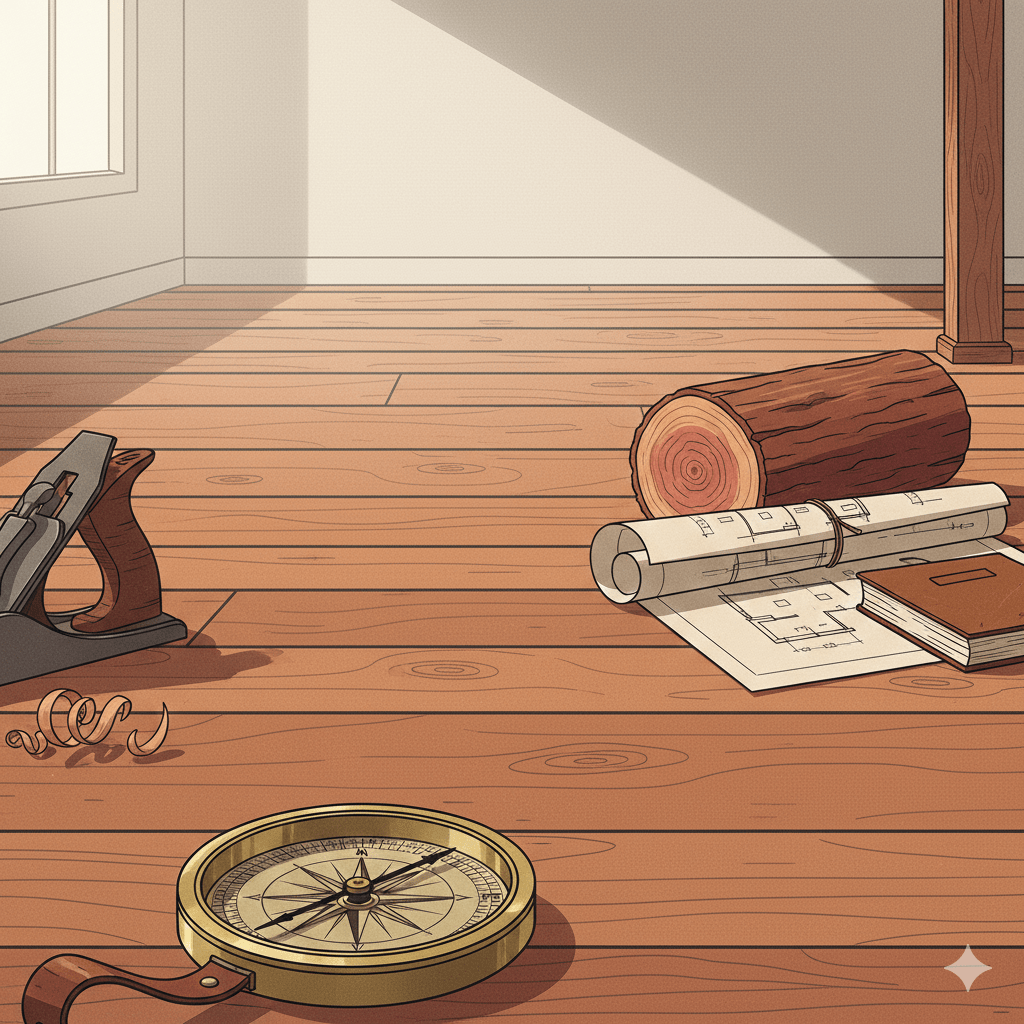
After painting came flooring. And I had a very specific vision: wide plank flooring with exposed face nails, just like colonial homes from the 1700s. Old growth wood with character. Reclaimed if possible. The authentic historical look.
The Connor Homes kit included flooring as an option. It was beautiful — I think it was reclaimed wide plank. It was also obscenely expensive.
So I went searching for an alternative that would give us the old house aesthetic without the old house price tag.
The Heart Pine Discovery
Through extensive internet research and calling around for samples, I discovered Heart Pine flooring. Heart Pine is cut from the heartwood of old-growth pine trees and is significantly harder than regular white pine. It’s not as hard as oak or other hardwoods, but it’s a middle ground — harder than soft pine, cheaper than hardwood, with the wide plank aesthetic we wanted.
I contacted multiple companies, compared samples, and eventually settled on Timeless Wood Floors out of Villa Rica, Georgia.
What We Ordered:
- 12-inch wide Heart Pine boards
- 3/4-inch thick
- Cottage grade (had knots and character; clear grade was way out of budget)
- Cost: approximately $12,000 for the whole house
The company brought it up themselves on a trailer and delivered it to our house. We stored it in the basement until we were ready to install.
This would turn out to be a mistake for reasons I’ll get to.
The Finish Formula (Or: How to Make Everything Complicated)
Jennifer and I wanted a dark, aged wood look. Not the light natural pine color. We wanted it to look like 200-year-old floorboards that had darkened and warmed over time.
Simple, right? Just buy some stain and apply it.
Wrong.
I tried various stains from the big box stores — MinWax and others. Too light. Too orange. Too something. Nothing looked right.
Then I found Penofin stain. The walnut color was close but too dark when applied directly to raw wood. It would over-saturate and black out the grain.
So I developed a multi-step process that I’m sure professional floor finishers would laugh at:
Step 1: Tung Oil Base Real Milk Paint Company’s natural tung oil, thinned with citrus solvent to penetrate the wood. This sealed the wood slightly so the stain wouldn’t over-penetrate.
Step 2: Penofin Stain Penofin in Mahogany color. Applied over the tung oil base, it gave a warm dark color without completely obscuring the grain.
Step 3: Waterlox Original Satin Finish This is where things got toxic. Waterlox Original is not VOC compliant. I had to order it in quarts — 32 or more quarts for the whole house. It’s a solvent-based finish that off-gasses like crazy and is about as toxic as you can get while still being legal to sell.
But it gives a beautiful, warm, durable finish.
I didn’t know about the non-toxic version at the time. I just knew the Original was what people recommended for high-quality floors.
The Face Nails: To complete the historical look, we ordered Tremont Steel Cut Nails from Tremont Nail Company in Mansfield, Massachusetts. These are reproduction nails made the old-fashioned way, with a tapered square profile.
We couldn’t drive them too deep because we only had 3/4-inch boards over 3/4-inch plywood, and beneath that was the radiant floor heating. Go too deep and we’d puncture the radiant tubing. That would be a nightmare.
So the nails were short, decorative, and spaced 2-3 feet apart with three nails across the width of each board.
The Moisture Problem (Again)
Remember how I mentioned we stored the flooring in the basement while the house was being finished?
The basement where we were also storing the trim that was absorbing moisture? The basement in the house that was saturated from spray foam curing, drywall mud drying, and paint off-gassing?
Yeah. The flooring absorbed moisture.
I checked it with a moisture meter before installation. The reading seemed impossibly high. I thought the meter must be wrong.
The meter was not wrong. I was wrong.
But we were on a schedule, and I convinced myself it would be fine. The wood would acclimate. It would dry out once installed.
This assumption would come back to haunt me.
The Installation
My friend and his nephew handled the installation. They glued the boards down and then face-nailed them with the Tremont nails.
The Challenge: Heart Pine splits easily. Really easily. Every nail hole had to be pre-drilled or the board would crack. This turned a straightforward nailing job into a massive undertaking — pre-drill hundreds of holes, then nail them by hand.
We did the entire house in Heart Pine: living room, dining room, kitchen, bedrooms, hallways, bathrooms. Everything.
The logic: older houses used wood floors everywhere. It would look consistent. It would be simpler than switching materials for different rooms.
Looking back: We probably should have tiled the bathrooms. With kids, bathrooms get flooded. Wood floors in bathrooms are not ideal. But at the time, it seemed like the authentic choice.
The Nail Tapping Nightmare (PTSD Part Two)
After the floor was installed, I hired a professional floor sander to come sand it smooth and prep it for finishing.
He looked at the floor and said, “You might want to tap those nails down. Otherwise, when I sand over them, you’re going to have shiny metal spots all over your floor.”
I had hundreds — maybe thousands — of nails in the floor. All of them needed to be tapped down slightly below the surface using a nail punch and hammer.
The Process: Take the punch. Position it on the nail head. Swing the hammer with enough force to drive the nail down about 1/16 of an inch. Repeat. For every. Single. Nail. In the entire house.
What Actually Happened: I developed literal PTSD from this process. I would swing the hammer, miss the punch, and smash my finger. Over and over and over. I don’t know how I didn’t break a finger. I must have hit myself hundreds of times.
I started to fear swinging the hammer. I’d hesitate, which made it worse. I’d get tired, which made my aim worse. More smashed fingers.
I tapped some nails too far and created divots in the wood. I missed some nails entirely. Ironically, the ones I missed looked better because they still sat slightly proud and caught the light, which was the original aesthetic anyway.
But I was committed to the process, so I tapped them all down. Every last one. With my increasingly bruised and swollen fingers.
The Finishing Process (Enter the Toxic Haze)
After the professional sanded the floor, it was my job to apply all the finish coats.
Coat 1: Tung Oil This wasn’t too bad. The citrus solvent made it smell like oranges. I could have the windows open. I probably wore a respirator, but I don’t remember.
I made special cardboard shoes so I could walk on the wet finish without leaving footprints. This mostly worked. Except when I left a can of thinner sitting on the floor and it left a small ring that darkened when the stain went on. And a spot where I stepped in solvent that also darkened. These imperfections are permanent and only I notice them, but they’re there.
Coat 2: Penofin Stain One or two coats, I can’t remember which. This is where the color started to really develop.
Coat 3 & 4: Waterlox Original This is where things got really unpleasant.
Waterlox Original is incredibly toxic. Even with all the windows open, fans running, and wearing a respirator, I would get headaches. The fumes permeated everything. The house reeked of solvent.
You’re supposed to apply two coats and sand lightly between them. Each coat takes time to dry. The whole process took days.
I may have taken a week off work to finish this. Or worked from home while the house was uninhabitable. I honestly don’t remember. I just remember the toxic haze.
The Rag Fire Hazard: All the rags I used with the solvent-based products were potential fire hazards. They can spontaneously combust if left in a pile. So I’d spread them out in the yard to dry before disposing of them.
This added paranoia to the already unpleasant experience of poisoning myself with floor finish.
The Variations
Bathrooms and Laundry Room: I used polyurethane instead of Waterlox in the bathrooms and laundry room because I thought it would be more waterproof. I’m not sure that was correct, but that’s what I did.
We’ve had some issues where water sits — like by the fridge where the kids drop ice constantly — and it does something to the finish. But it’s not catastrophic.
The Attic: When we eventually put flooring in the attic, we used regular 6-inch pine (not Heart Pine) and painted it white with Benjamin Moore porch paint.
This was a mistake.
I rolled the paint on. The roller texture didn’t flatten out. It stayed in the finish. Forever.
I should have brushed it, or used a much finer nap roller. The textured finish bugs me every time I see it.
The Stairs: I somehow miscounted the treads we needed. We had ordered clear grade (no knots) for the stairs to make them look nicer. But we were one or two treads short.
I had to go to a big box store and buy pine treads to match. They weren’t Heart Pine, but with the same staining process, they matched fairly well.
The Problems (Fifteen Years Later)
Problem 1: Gaps Between Boards The wide boards shrank. In some spots, gaps opened up — maybe 1/8 inch in places. Not everywhere, but noticeable.
This is what happens when you install wood that hasn’t dried properly. The wood continues to dry after installation and shrinks.
When I eventually refinish the floor, I can use Dr. Schutz Xtra Fill (a German product) mixed with sawdust from the floor to fill these gaps. It accepts stain and won’t crack out like regular wood filler.
Problem 2: The Trike Line Disaster A few years after we moved in, we had kids. We bought them a trike from Amazon. It was a foldable trike with inline-skate wheels that I thought would be perfect — quiet, smooth, good for riding around the house.
We specifically built the house with a loop so kids could run/ride around in circles, just like I did growing up.
What I didn’t realize: the wheels on this trike were too hard. Way too hard.
Our son rode around and around and around the loop. Hundreds of times. And the hard wheels left tiny ridges in the Heart Pine floor. Little lines everywhere.
By the time I noticed, the damage was done.
I had to research tire compounds, find softer wheels, and swap them out. The new wheels didn’t make lines. But the old lines are still there.
Problem 3: The Fridge Grooves One day I needed to pull out the refrigerator to access something behind it. The fridge was empty when I first installed it, so it slid easily.
This time, it was full. It was heavy. And I didn’t put protection under it.
I pulled the fridge forward and it left permanent grooves in the Heart Pine.
Now, whenever I need to move the fridge, I have to put down thin sheets of Masonite or plywood first. Lesson learned the hard way.
Problem 4: Splitting and Cracking Heart Pine is somewhat fragile. In several spots, the wood split or cracked — probably due to the moisture content when it was installed combined with the wood drying out unevenly.
I had to glue some pieces back down. It’s not a huge problem, but it’s there.
Problem 5: Too Dark The finish we chose looks great. It has that aged, warm, dark tone we wanted.
But it shows every speck of dust. Every footprint. Every particle of anything.
In hindsight, we probably should have gone with a lighter honey color. It would have been more forgiving for daily living.
Problem 6: Soft Wood Everything Heart Pine is harder than regular pine, but it’s still soft compared to oak or maple. It gets dents. It gets scratches. It gets lines from furniture, from hard wheels, from dropping things.
After fifteen years of living on it, the floor has character. Lots of character. Maybe too much character.
But it also feels authentic to an old house. A 200-year-old house wouldn’t have perfect floors. They’d be worn, dented, scratched, and full of history.
Our floors just achieved that state faster than expected.
What We Got Right
1. The Aesthetic The wide plank floors with face nails look exactly like what we wanted. They’re beautiful. They’re distinctive. They give the house character.
2. Consistent Throughout Using the same flooring everywhere created a cohesive look and simplified the installation. No transitions, no mixed materials, just one continuous floor throughout the house.
3. The Finish Combination The multi-step finish process was complicated, but the result is gorgeous. The warm, dark tone with visible grain is exactly what we were going for.
4. Doing It Ourselves (Sort Of) We hired professionals for the parts that needed professional skills (installation, sanding), but we did the finishing ourselves and saved money.
5. The Nails The Tremont cut nails are perfect. They look exactly like old hand-forged nails. The divots from tapping them down actually add to the aged aesthetic.
What We Got Wrong
1. Moisture Management (Again) This is a recurring theme. We stored the wood in a damp basement. We didn’t let it dry properly. We installed it wet. This caused gaps, cracking, and splitting.
2. Not Tiling the Bathrooms With kids, wood floors in bathrooms are not ideal. We should have tiled them.
3. Choosing Too Dark a Finish The dark color shows everything. A lighter honey tone would have been more practical.
4. Using Toxic Waterlox Original There were less toxic options available. I just didn’t know about them or didn’t research enough.
5. Not Protecting the Floor from Hard Wheels The trike disaster could have been avoided if I’d checked the wheel hardness before letting the kids ride on the floor.
6. Rolling the Attic Paint The roller texture is permanent and annoying. I should have brushed it.
7. Tapping All the Nails Down Some of the nails I didn’t tap look better. The ones I tapped too far created divots. The whole process caused finger trauma. Maybe I should have just left them alone and lived with a few shiny spots.
Would We Do It Again?
Yes:
- Heart Pine as a budget alternative to reclaimed wood
- Wide plank aesthetic with face nails
- Hiring professionals for installation and sanding
- The multi-step finish process (though maybe with less toxic products)
Differently:
- Let the wood dry properly before installation
- Choose a lighter finish color
- Tile the bathrooms
- Use less toxic finish products
- Check wheel hardness on anything with wheels
- Brush painted floors instead of rolling them
- Maybe not tap every single nail down with a hammer and punch
Never Again:
- Install flooring that hasn’t been properly dried
- Use Waterlox Original (the toxic version) in an occupied house
- Roll paint on a floor
The Current State
We haven’t refinished the floors. The trike lines, divots, scratches, and gaps are all still there. The finish has worn in some high-traffic areas.
But honestly? The imperfections give it character. The floors look lived-in. They look old. They fit the house aesthetic we were going for.
Only I notice most of the flaws because I’m the one who created them. Jennifer doesn’t notice. Guests certainly don’t notice. They just see beautiful wide plank floors with old-style nails.
When we do eventually refinish them — and we will, someday — I’ll use Dr. Schutz Xtra Fill mixed with sawdust to fill the gaps and divots. I’ll probably go with a lighter stain color. And I’ll use a less toxic finish product.
But for now, we’re living with floors that look like they’ve been here for 200 years instead of 15.
Mission accomplished, I guess?
Overall Assessment
The Heart Pine flooring was a good choice for the budget and aesthetic we wanted. The installation was done well. The finish process was complicated but successful.
The problems we’ve had — gaps, scratches, trike lines, splits — are mostly due to the moisture content when we installed it and the fact that Heart Pine is a softer wood than oak or maple.
But the end result is beautiful, distinctive, and exactly what we were going for: wide plank floors that look old and authentic.
The cost in time, finger injuries, toxic exposure, and stress was significant. Would I do it again? Probably not. But I’m glad we did it.
Grade: B-
Beautiful result, matches the aesthetic perfectly, accomplished the goal. But significant problems from improper drying, ongoing maintenance issues, and way more work than anticipated. The toxic finish process alone should probably drop this to a C, but the floors look so good I’m bumping it back up.
Also, I still have all my fingers, despite the nail-tapping trauma. That has to count for something.
Next up: Part 16 – The Chimney Catastrophe (Or: Why a Fireplace Takes Up 3 Feet in the Center of Your House)
 Even that's Odd
Leave a comment