
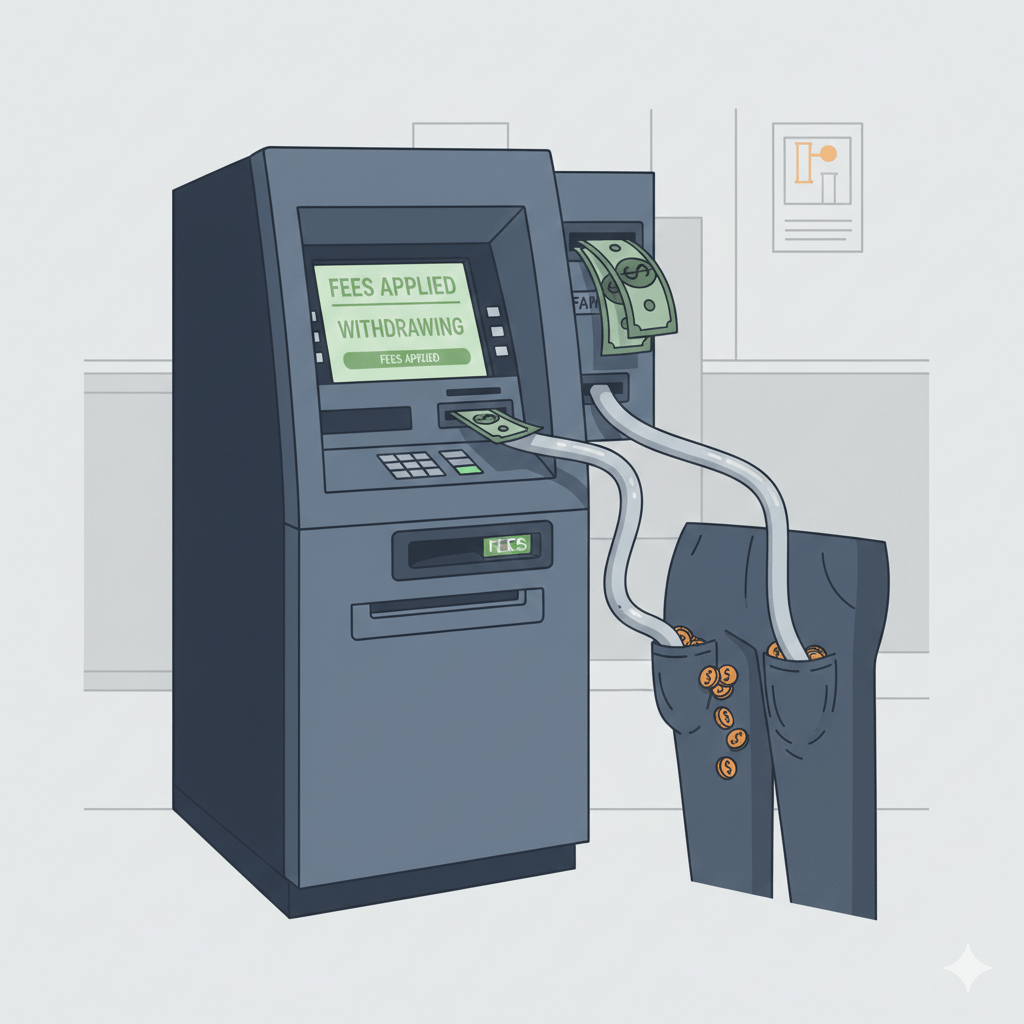
The Poverty Tax
Maria works two jobs. Monday through Friday, she’s a home health aide making $15/hour. Weekends, she works retail at Target for $16/hour. Between both jobs, she brings home about $2,400/month after taxes.
It’s not much, but she manages. Carefully.
On Friday, she deposited her paycheck from the home health agency—$680 for the week. She deposited it at the ATM at 5:30 PM because her shift ended at 5:00 and the bank closes at 5:00.
The deposit showed in her account immediately: “Pending – Available Monday.”
Her rent auto-pays on the first of the month. Today is Friday, November 1st. She thought she was fine. The deposit was Friday, rent pulls Monday, deposit clears Tuesday—she’d seen this work before.
It didn’t work this time.
Monday morning, her rent payment of $1,100 processed. Her account balance: $680 (the pending deposit didn’t count).
Overdraft Fee: $35
The bank paid the rent (how generous!) and charged her $35 for the privilege.
Balance: -$455
Maria immediately transferred $500 from her savings account—the $400 she’d been building for emergencies plus $100 more.
Transfer Fee: $10 (savings-to-checking transfer)
Balance: $35
On Monday, she bought groceries: $18 at Aldi, carefully chosen. Approved.
Balance: $17
Tuesday, she stopped for gas: $25. Approved.
Balance: -$8
Overdraft Fee: $35
Balance: -$43
Tuesday afternoon, she grabbed coffee and a breakfast sandwich before her shift: $8.47. Approved.
Balance: -$51.47
Overdraft Fee: $35
Balance: -$86.47
Tuesday evening, she picked up her prescription: $15 copay. Approved.
Balance: -$101.47
Overdraft Fee: $35
Balance: -$136.47
Wednesday morning, her paycheck from Target deposited: $340. Finally.
Balance: $203.53
Maria worked two jobs all week. She made $1,020. After rent, actual expenses ($66.47), and bank fees ($150), she had $203.53 left for the rest of the month.
The bank took $150—nearly 15% of her weekly income—because her deposit cleared Tuesday instead of Monday.
And here’s what Maria didn’t know: The bank reordered her transactions.
The Reordering Scam
Here’s what actually happened to Maria’s account, in chronological order:
Monday:
- 6:00 AM: Rent payment requested ($1,100)
- 9:00 AM: Grocery purchase ($18)
Tuesday:
- 8:00 AM: Gas ($25)
- 11:00 AM: Coffee ($8.47)
- 5:00 PM: Prescription ($15)
- 11:59 PM: Paycheck deposit ($680 – clearing)
The bank could have processed these in chronological order:
- Groceries ($18) – Balance: $662 ✓
- Gas ($25) – Balance: $637 ✓
- Coffee ($8.47) – Balance: $628.53 ✓
- Prescription ($15) – Balance: $613.53 ✓
- Paycheck deposits (+$680) – Balance: $1,293.53 ✓
- Rent ($1,100) – Balance: $193.53 ✓
Total overdraft fees: $0
But banks don’t process chronologically. They process largest to smallest—on purpose.
Here’s what Maria’s bank actually did:
- Rent ($1,100) – Balance: -$420 → $35 fee
- Gas ($25) – Balance: -$480 → $35 fee
- Groceries ($18) – Balance: -$533 → $35 fee
- Prescription ($15) – Balance: -$583 → $35 fee
- Coffee ($8.47) – Balance: -$626.47 → $35 fee
- Paycheck deposits (+$680) – Balance: $53.53
Total overdraft fees: $175 (even worse than Maria realized—the transfer from savings covered one)
Same transactions. Same day. Different order. $175 in fees instead of $0.
This isn’t an accident. This is bank policy. It’s literally in the fine print of your account agreement. They call it “processing efficiency.” It’s actually called “maximum fee extraction.”
Wells Fargo got caught doing this. They settled a lawsuit for $203 million in 2010. They promised to stop.
Then they kept doing it. In 2020, they settled another lawsuit for $98 million for the same practice.
Bank of America settled for $66.6 million in 2011 for transaction reordering.
JPMorgan Chase settled for $110 million in 2011.
They all promised to stop. They all changed their disclosures. Many kept doing it anyway—just with better legal language.
The Scale of Extraction
2023 Overdraft Fee Revenue: $9 billion (down from $33 billion in 2019 after regulatory pressure)
Let that number sit for a moment. Banks collected $9 billion in overdraft fees in a single year. Not interest on loans. Not fees for services rendered. Fees for letting your account go negative—often by pennies—for a few hours.
Who pays these fees?
- 9% of account holders pay 84% of all overdraft fees
- These are the people who can least afford it
- Average household income of frequent overdrafters: $26,000
- They pay an average of $380/year in overdraft fees
If you make $26,000/year and pay $380 in overdraft fees, that’s 1.5% of your annual income going to banks for the crime of being poor.
The poverty trap:
- Low balance → overdraft fee
- Overdraft fee → lower balance
- Lower balance → more likely to overdraft again
- Repeat until you give up and close the account (or the bank closes it for you)
The Full Fee Extraction Menu
Overdraft fees are just the beginning. Here’s what banks charge low-balance customers:
Monthly Maintenance Fees: $12-$35/month
Most “free checking” accounts aren’t free. They’re free if you:
- Maintain a minimum daily balance ($1,500-$5,000)
- Have direct deposit of $500+ per month
- Have a linked savings account with $5,000+ balance
- Are under 25 and in school
If you can’t meet these requirements—because you’re poor—you pay $12 to $35 per month just to have a checking account.
Annual cost: $144-$420/year for the privilege of having a place to deposit your paycheck
If you have $5,000 sitting in your checking account, you don’t need a checking account to survive. You have savings. The maintenance fee is literally a poverty tax.
Out-of-Network ATM Fees: $4.73 average
- Your bank charges you: $3.00
- The ATM owner charges you: $3.14
- Total: $6.14 for accessing your own money
If you’re poor, you probably don’t live near your bank’s ATMs. You use whatever’s available. Two withdrawals a week: $638/year to access your own money.
Other Fee Highlights:
- Paper statement fee: $2-5/month ($24-60/year) – because banks want you to go paperless
- Card replacement fee: $5-25 (your card expires, you pay to get a new one)
- Stop payment fee: $30-36 (you need to stop a payment, you pay)
- Wire transfer fee: $15-50 (sending your own money somewhere)
- Cashier’s check fee: $10-15 (getting a guaranteed check)
- Account closure fee: $25-50 (some banks charge you to close your account)
- Dormant account fee: $5-20/month (didn’t use your account? Pay us.)
Every single one of these used to be free—or didn’t exist. Banks absorbed these costs as the price of having customers.
Now they charge you. Because they can.
How We Got Here: The Death of Free Checking
Pre-2008:
- Free checking was standard at most banks
- 76% of checking accounts were free with no conditions
- Overdraft was opt-in (you had to explicitly agree)
- Transaction ordering was chronological at most banks
Post-2008:
- Banks lost revenue from debit card interchange fees (thank you, Dodd-Frank reform)
- They needed to make up that revenue somewhere
- Free checking disappeared—now only 23% of accounts are free with no conditions
- Overdraft “protection” became opt-out (you’re enrolled unless you say no)
- Transaction reordering became standard (largest-first to maximize fees)
Here’s the bait-and-switch: They call it overdraft “protection” and act like they’re doing you a favor by covering the transaction.
But you didn’t ask them to.
You’d rather have the card declined than pay $35 for a $3 coffee. But they don’t give you that choice in the moment. They “protect” you, then charge you for the protection you didn’t want.
And the fine print you signed when you opened the account? It says you opted in. Even though you probably didn’t realize what you were agreeing to.
The Unbanked: Pushed Out Entirely
When the fees become too much, people give up on banks entirely:
- 5.9 million households (4.5%) are “unbanked”—no checking or savings account at all
- 25.2% of Black households are unbanked or underbanked
- 14.1% of Latino households are unbanked or underbanked
Where do they go instead?
Check Cashing Services
- Fee: 1-12% of check value (average 1.95%)
- $500 check = $10 fee
- If you get paid biweekly: $260/year just to access your wages
Payday Loans
- Average APR: 391%
- $500 loan for two weeks costs $75
- Can’t pay it back? Roll it over for another $75
- Average borrower ends up paying $520 in fees on a $375 loan
Prepaid Debit Cards
- Monthly fee: $5-10
- Per-transaction fee: $0.50-2.00
- ATM fee: $2.50
- Adding money to card: $3-5
- Annual cost: $200-400
Being unbanked costs more than being banked. But when banks charge you $150 for a processing quirk, people give up.
And the alternatives are worse. By design.
Who Profits?
Top 4 Banks (2023):
JPMorgan Chase
- Total profit: $49.6 billion
- Overdraft/NSF fee revenue: ~$1.5 billion
Bank of America
- Total profit: $27.4 billion
- Overdraft/NSF fee revenue: ~$1.0 billion
Wells Fargo
- Total profit: $19.1 billion
- Overdraft/NSF fee revenue: ~$1.0 billion
Citigroup
- Total profit: $14.8 billion
- Overdraft/NSF fee revenue: ~$0.8 billion
Combined profit of top 4: $110.9 billion Combined overdraft revenue: ~$4.3 billion
These are the same banks that:
- Got bailed out in 2008 with your tax money
- Paid billions in fines for illegal practices
- Continued the same practices with better legal language
- Pay their CEOs an average of $20-30 million/year
Jamie Dimon, CEO of JPMorgan Chase, made $34.5 million in 2023. That’s what 23,000 overdraft fees would cover.
In other words, customers overdrafting their accounts—people who literally don’t have enough money to cover their rent and groceries—paid the equivalent of one CEO’s salary.
The Design
This isn’t accidental. This isn’t market forces. This is designed extraction:
Step 1: Eliminate free checking
- Make basic banking conditional on having money
- Charge poor people for being poor
Step 2: Make overdraft opt-out instead of opt-in
- Enroll everyone by default
- Bury opt-out in fine print
- Train tellers to pitch it as “protection”
Step 3: Reorder transactions to maximize fees
- Process largest first, not chronological
- Turn one overdraft into five
- Settle lawsuits, promise to stop, keep doing it with better disclosures
Step 4: Make customer service deliberately difficult
- Long hold times to reverse fees
- Require branch visits during business hours (when you’re working)
- Train reps to deny first request, approve only if customer pushes back
- Count on people giving up
Step 5: Push the unbanked to worse alternatives
- Make banking so expensive people quit
- Let payday lenders and check cashers extract even more
- Benefit from the comparison (at least we’re not charging 391% APR)
Every single step was a choice. Free checking didn’t disappear because it was unsustainable—banks made record profits before and after. Transaction reordering didn’t happen because it’s efficient—it happens to maximize fee revenue.
They chose to extract from people who have nothing.
The Shift
Remember Part 2? Remember when we talked about what used to be normal?
1970s banking:
- Free checking accounts (truly free)
- No overdraft fees (or rare, and small)
- No ATM fees (ATMs didn’t exist yet, tellers were free)
- No monthly maintenance fees
- Banks competed for your business by offering service
Banks made money by:
- Lending out your deposits at higher rates than they paid you
- Providing services to attract deposits
- Relationship banking (you stayed loyal, they treated you well)
2024 banking:
- “Free” checking (with conditions you can’t meet if you’re poor)
- $35 overdraft fees on $5 transactions
- $6 ATM fees to access your money
- $12-35/month maintenance fees
- Banks compete on stock price, not service
Banks make money by:
- Still lending your deposits at higher rates
- Charging you fees for everything
- Extracting maximum revenue from customers who can’t leave
- Quarterly earnings reports matter more than customer relationships
The shift: From banks providing a service (and making money from the spread) to banks charging for access to your own money.
They used to compete for your business. Now they extract from your poverty.
Maria’s Reality
Remember Maria? The home health aide who lost $150 to overdraft fees because her deposit cleared Tuesday instead of Monday?
She’s not irresponsible. She’s not bad with money. She deposited her check the day she got it. She had rent covered. A processing delay—something completely out of her control—cost her 15% of her weekly income.
Maria makes $28,800/year working two jobs. She can’t afford a financial advisor. She can’t afford to keep $5,000 in her checking account to avoid fees. She can’t afford to take time off work to go to a branch to dispute fees.
The bank knows this. They count on it.
And that $150? That’s groceries for two weeks. That’s her copay and medication. That’s the emergency fund she was trying to build.
The bank took it for processing a transaction that could have been ordered differently. For free.
What’s Next
We’ve shown you the math doesn’t work (Part 1). We’ve shown you how costs shifted while wages stagnated (Part 2). Now you see how banks extract billions from the people who can least afford it.
But banks aren’t the only ones. In Part 4, we’re looking at credit cards—the debt trap that 45% of Americans depend on to cover basic expenses. Where $6,501 in average credit card debt costs $1,368/year in interest at 21% APR.
Spoiler: The same banks charging Maria $35 overdraft fees are charging 21-29% interest on credit cards while paying 0.01% on savings accounts.
They’re not just shifting costs. They’re profiting from both ends of your financial struggle.
And they’re just getting started.
Passing the Buck: Why We Pay More But Make Less is a 15-part series examining how corporations and government systematically shifted costs onto working Americans—while wages stagnated and benefits disappeared.
 Even that's Odd
Leave a comment