
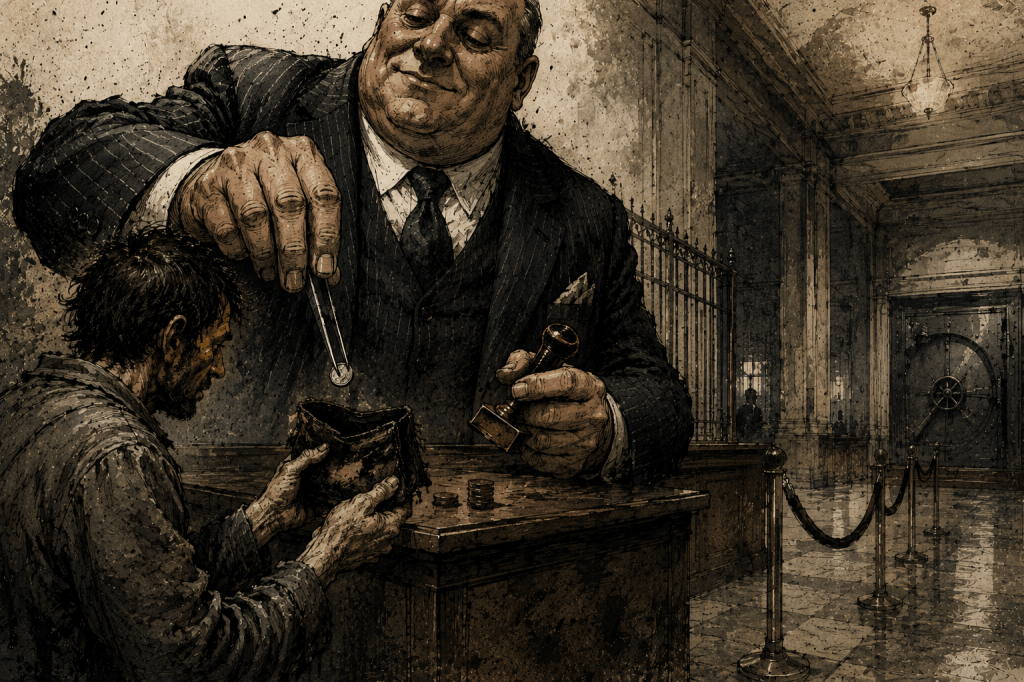
Part 3 of Passing the Buck, a 15-part series on why we make less but pay more.
In Parts 1 and 2 I walked through the picture: the math on a typical American household has tightened over fifty years even as productivity has climbed, and several specific costs — housing, healthcare, higher education, transportation, retirement — have shifted from one set of books to another. From this installment forward, I want to look at the specific places where the extraction happens, one cost at a time. The premise of each piece is the same: that a cost which used to sit in one part of the system now sits, deliberately, in another.
The first one is banking.
The basics, briefly
The U.S. consumer banking industry collected approximately $15.5 billion in overdraft and non-sufficient-funds fees in 2019, per the Consumer Financial Protection Bureau’s compilation of bank Call Reports and small-institution estimates. By 2023, that number had come down — to roughly $9 billion industry-wide — largely because the CFPB and a handful of major banks ran reforms after a decade of regulatory pressure and class-action litigation. So we are talking, currently, about something on the order of $9 billion a year, and historically (in the pre-pandemic period) roughly $15 billion a year, taken out of one specific group of customers in fees on accounts where their available balance went temporarily negative.
The CFPB’s own analysis finds that those fees are very unevenly distributed. Under nine percent of all checking accounts incur ten or more overdrafts per year, and that under-nine-percent group is responsible for roughly eighty percent of the total overdraft-fee revenue. In other words, the people paying for this are not the broad customer base. They are a specific, narrow slice of customers — the customers whose balances are lowest. The fee structure is not on the customers with the most money in the bank. It is on the customers with the least.
This is the part worth pausing on, because the asymmetry is the design.
How the fee structure works
The mechanism is straightforward, and it was litigated heavily for about a decade. When you authorize a transaction on a debit card, the bank can either decline it (which costs you nothing, beyond the inconvenience) or pay it (which currently costs about $35 on average in fee, even if the transaction itself is a four-dollar coffee). For most of the period from roughly 2001 to roughly 2014, the largest U.S. retail banks defaulted to paying rather than declining, and they presented this to customers as “overdraft protection” — language designed to make the customer feel that the bank was doing them a favor. The customer, in most cases, had not affirmatively asked for the favor. They had been opted in by default, in the fine print of the account-opening paperwork.
The second piece of the mechanism was transaction reordering. When you have several transactions hitting your account on the same day, the order in which they are processed determines how many of them push your balance below zero. If a bank processes them in the order they actually occurred, a single overdraft might trigger one $35 fee. If the bank processes them largest-first — your $1,100 rent payment, then your smaller purchases — that same set of transactions can trigger four or five overdraft fees in succession, even though the net activity for the day is identical.
Several of the major banks did this systematically. In Gutierrez v. Wells Fargo, U.S. District Judge William Alsup found in 2010 that Wells Fargo’s high-to-low reordering for California debit-card customers had been a deliberate practice to maximize fee revenue, and ordered roughly $203 million in restitution. The case dragged through the Ninth Circuit and ultimately the Supreme Court, which declined review in 2016, finalizing the judgment. In the broader multi-district class action that followed in Florida, Bank of America settled for roughly $410 million in 2011, and JPMorgan Chase settled for roughly $162 million in 2013. The practice was determined in court to be a knowing maximization of fee revenue at the customer’s expense.
After that wave of litigation, most large banks moved away from purely high-to-low ordering for debit transactions. Some moved further — Bank of America reduced its overdraft fee to $10 and eliminated NSF fees in 2022; Capital One eliminated overdraft fees entirely. But the underlying business model — a fee structure that falls overwhelmingly on the customers with the smallest balances — is still very much intact at most banks, in lower volume.
Where the money still comes from
A retail bank makes money in two main ways. It takes deposits and lends them out, capturing the spread between what it pays depositors and what it earns on loans. And it charges fees. Until roughly the 1980s, the spread was the main source of revenue and fees were minor. Over the past forty years the mix has shifted. Free checking, which was nearly universal as a standard product into the early 2000s, has largely disappeared as an unconditional offering. The most recent Bankrate surveys put the share of accounts that are free with no conditions at well under half of what it was in the early 2000s. To get free checking today at most large banks you need to maintain a minimum balance, set up a direct deposit, or link a savings account with a substantial balance — all of which is to say, you need to already have money. Which is to say the people who get free banking are the people who least need it.
The customers without those buffers pay monthly maintenance fees of roughly twelve to thirty-five dollars, on top of any overdraft, ATM, paper-statement, or wire-transfer fees that hit during the month. When the math gets too tight, people leave the banking system entirely. The FDIC’s most recent national survey found roughly 4.5 percent of American households are unbanked — no checking or savings account — with much higher rates among Black and Latino households. The alternatives for unbanked households (check-cashing services, prepaid debit cards, payday lenders) extract their own fees, often higher in percentage terms than the bank fees the customer was trying to escape. Pew has tracked payday-loan effective APRs well above 300 percent on small short-term loans. The customer in the worst position to absorb extraction is, by design, the customer absorbing the highest rate of it.
The simple version
What happened in the banking sector over the past forty years is what happened in healthcare, in higher education, in retirement security: a cost that used to be absorbed by the institution — the bank, the employer, the state — got moved onto the customer. Free checking was a product banks used to offer to attract deposits, and they made money on the deposits. Modern banking offers free checking conditionally, charges fees aggressively for any lapse in maintaining the conditions, and concentrates those fees on the customers with the smallest balances. The total revenue from those fees has been a meaningful share of consumer-banking profit for the largest banks for most of the past two decades.
The reforms of the past few years — CFPB analyses, the litigation in the early 2010s, the policy changes at Bank of America and Capital One — have reduced the worst version of this. It is meaningfully better than it was a decade ago, and the regulatory work, the class actions, and the public attention all deserve credit for that. But the underlying structure — fees as a primary revenue line, concentrated on low-balance customers — has not changed. It has only been pared back at the edges.
The reason this is in a series called Passing the Buck is that the pattern is the same as everything else in the series. The cost did not go away. It moved. The bank’s cost of serving a low-balance customer used to be a cost of doing business. It is now a fee charged to that customer. The customer pays for being a customer.
The next installment looks at credit cards, which is the other side of the same coin.


Leave a Reply