
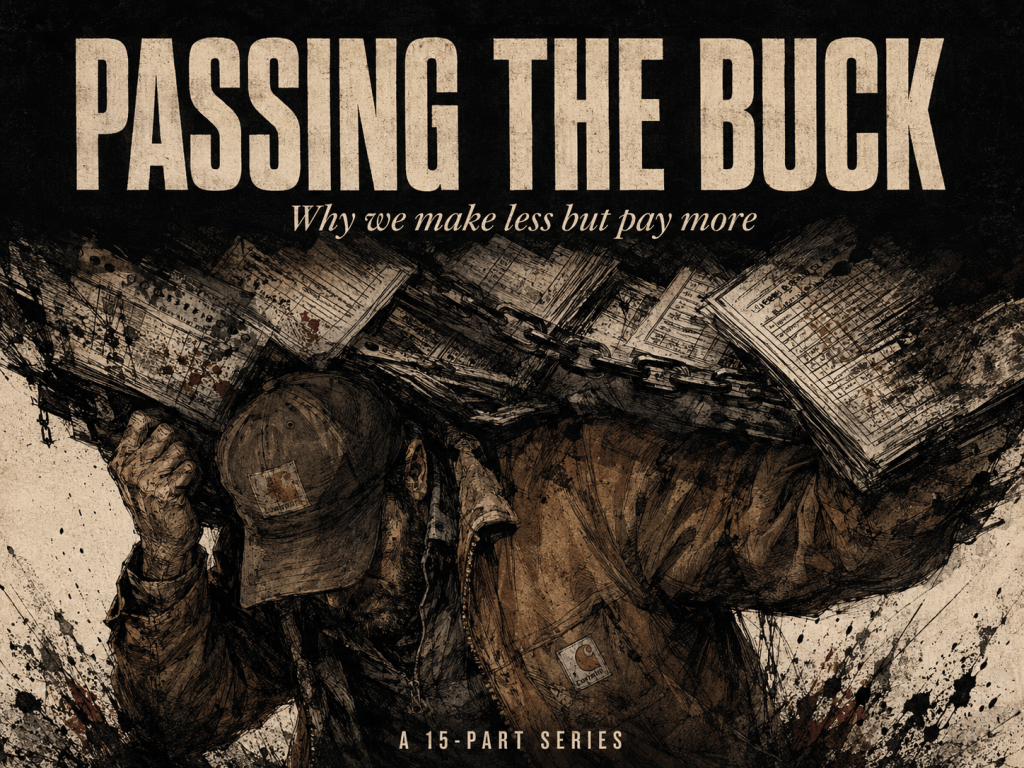
Why we make less but pay more — and how it got that way
If you’re working hard and still falling behind, you’re not imagining it. The math really doesn’t add up anymore. A median American income in 2026 doesn’t cover a median American life — and that gap isn’t an accident, a personal failing, or the inevitable cost of progress. It was built. Deliberately. Over the last 50 years.
This series is a 15-part walk through how we got here. Each installment looks at one specific way costs got shifted off corporations and government and onto individual workers — banking fees, credit card debt, forced car ownership, food monopolies, telecom, insurance, all the small charges that have quietly become the largest line items in most household budgets. Then it follows the money. Then it names who profits and who voted to let them. Then it shows what the alternatives actually look like in countries that made different choices.
If you’re new to the series, start at Part 1. If you’ve been reading along, this page is also the easiest way to share the whole thing with someone else.
The Series
Part 1: The Impossible Math
Meet Sarah, a registered nurse making $77,000 — well above the median. Here’s why she still can’t afford a normal life.
Part 2: The Baseline Shift
How “basic survival” got redefined as luxury. What a single median income bought a family in 1970 — and what it buys now.
Part 3: Banking Fees
The poverty tax. Why the people with the least money pay the most to access their own paychecks.
Part 4: Credit Cards
The debt trap. How a 1978 Supreme Court decision turned credit cards into one of the most profitable extraction machines in American history.
Part 5: The Auto Trap
You don’t choose to own a car in most of America. The country was rebuilt to require one — and then the price of one was rebuilt too.
Part 6: Food Monopolies
A gallon of milk’s journey from a Wisconsin farm to your fridge. Why farmers make less and you pay more, with a handful of companies pocketing the difference.
Part 7: Phone and Internet
The monopoly you can’t escape. What happens to pricing when “competition” means a duopoly that quietly divides up the map.
Part 8: Insurance
Mandatory purchase, shrinking coverage. Why the healthiest, safest customers still pay more every year for less protection.
Part 9: Death, Taxes, and Everything In Between
The fee economy. One woman tracked every “convenience charge” and “service fee” for a month. The number is staggering.
Part 10: The Compound Effect
What happens when you add all nine cost categories together. Spoiler: 92.9% of one woman’s gross income, before she’s bought groceries.
Part 11: Who Profits?
Following the money. Every dollar of shifted cost goes somewhere — here’s the receipt.
Part 12: The Bipartisan Consensus
Why this system survives every change of administration. Both parties enabled it. Both parties protect it. Here’s the paper trail.
Part 13: How We Got Here
50 years of deliberate policy. Specific laws, specific court decisions, specific people. Not market forces — choices.
Part 14: What We Could Have Instead
It works elsewhere. Other developed countries face the same global pressures and don’t crush their workers under them. Here’s how.
Part 15: How We Get There
Building the power to win. The hard, slow, possible version of fixing this — without the comforting lies.
If you only read three parts, read Part 1 for the diagnosis, Part 11 for who’s collecting, and Part 15 for what to do about it.
If you want to share the whole series with one link, this is that link.
 Even that's Odd
Leave a comment